Padang Besar, Malaysia in the state of Perlis is the second most Northern checkpoint after Wang Kelian, another immigration border post in Perlis. In Malaysia, the town is called Padang Besar and it's similarly called "Padang Basah" in Thai province of Songkhla. However, Thais prefer to just call it "Padang". Most times during the non-holiday seasons Padang Besar is a quiet affair save for those commuters from Thailand and Malaysia on their daily cross border business and trade and travellers relishing a spicier adventure on their travels.
 |
| Pedestrian crossing either by vehicles or walking |
 |
| Immigration at the Train Station |
Padang Besar border crossing and immigration activities are perhaps the second most busy and active as compared to the Rantau Panjang - Su'Ngai Kolok border crossing. The reason, hordes of Malaysians especially the Malaysian Chinese on each weekends travel to Hatyai for religious reasons. Many in Malaysia today are Theravada Buddhist worshippers that's more closely related to the Indo-Chinese range of Buddhism. And however, if there are public and/or school holidays, Padang Besar becomes the alternative to Bukit Kayu - Danok crossing.
This weekend, as a continuation of this border crossing project, I did not realize that Malaysia is having the school holidays and thus even Padang Besar's vehicular and train crossings are inundated with travellers and tourists from Malaysia. I hated crowds and felt perplexed and the last time I came across these many people I fell ill. Luckily, this time again I took the train.
This two foreign girls, Micha and Justina, encountered a scam whilst trying to cross the border at the Padang Besar train station, at the Thai immigration section. This video is self explanatory and its not only the scam they faced but also harassment. Please watch this Youtube video which the both of them are kind enough to allow me to link on this blog:
Courtesy from Beer4Breakfast: Thanks so much, Micha and Justina
Despite some justifiable concerns, apparently Padang Besar is one of the safest land crossings in this region. The occasional touts that ferry passengers to the checkpoints or crossing the checkpoints may exacerbate the budget depending on the nature of the situation and the ignorance of the traveller, otherwise, if one is perhaps streetwise and aware of situations then the touts may backoff. As for myself, this time round, perhaps a little all familiar and with a body language that spoke of 'please backoff', and being too friendly, the Thai touts in reddish-orange jerseys understood.
This time round I will not be taking the train to Bangkok. It's a shuttle trip by train to Hatyai, about 45 minutes to an hour. More about this at the later sections of this blog.
 |
The station is long and can accomodate a couple
of trains on one platform.
|
 |
The other side is on renovation so pedestrians
are only using the vehicular bays' booths to
check their passports
|
Ah, yes, Padang Besar, compared with the other land-border crossings, this border has a train station ICQS (Immigration, Customs & Quarantine Services). Now there are two ICQS, the train station for the train travellers and the normal vehicle ICQS for pedestrians, commuters, and those that travel on vehicles. These are two separate entities. The train station ICQS is actually stationed on the Malaysian side of the border, and the train station ICQS is about 100 metres next to the vehicular and pedestrian ICQS. The train station ICQS incorporates both the Malaysian and Thai ICQS.
This Malaysian-Thai ICQS train station is supposed
to be a simple and straightforward setup, however, it seems that the Malaysian
authorities did not properly reassign this purpose. This mess was made after
when the KTM's Electric Express Train Services (commonly known as ETS) and the
Komuter (a communal inner-city/interurban city trains) started their services
beginning of last year. Hence, the diesel trains no longer in Malaysia and from
Thailand can use the rail services in the Northern region of Malaysia. The
reason, the rail lines are unsuitable for diesel trains because their
capacities are heavier. Moreover, the Thai trains capacity are absolutely and
entirely different from the Malaysian rail specifications. As a matter of fact,
there were some derailments when some of the diesel trains in Malaysia plied
the ETS rail lines in the Klang Valley. KTM are in the process of upgrading the
tracks. In the past there were direct train services between Butterworth
(Penang) and Bangkok, Thailand. However, after the upgrading for Malaysian
Northern trains to run in express electric mode, the Butterworth - Bangkok line
was shortened to Padang Besar - Bangkok only.
So what has amending the train services got to do with the disorganization at Padang Besar train station ICQS? Well, firstly, and in the past, passengers bought their tickets at the Butterworth station or book online in Malaysia. Today, we cannot, because today, we have to purchase it directly from the Thai train personnel based at Padang Besar. Secondly, all of us have boarded the train in Butterworth already and the train station ICQS at Padang Besar only serve to check our passports and our luggage items. Thirdly, Padang Besar was not a stopover. Hence, the security authorities understood the procedures requiring to clear and board passengers without hassle. Fourth, those days there weren't any ETS or Komuter trains; the only ones available were diesel trains and the services were pretty much lesser like perhaps twice a day only, hence there was minimal disruption between various services. Lastly, like I said, Padang Besar was not a stopover and its not a stopover for transfer of services as well, meaning transferring from a Thai train to a local Komuter train or boarding an ETS service Kuala Lumpur.
 |
| New Komuter train |
 |
| Old Komuter train plying from Taiping |
 |
| KTM ETS can be from Gemas or KL Sentral |
 |
| Used to be the Butterworth to Bangkok train but now its only the Padang Besar to Bangkok train and vice versa |
So, how many services reach Padang Besar as of today? (1) At least there are more than 5 ETS services plying from either Gemas, Johor - Padang Besar or KL Sentral - Padang Besar. (2) Then, there is the Komuter Service running from Taiping, Perak or Butterworth all the way to Padang Besar - compared to the ETS this is a station to station stop thus its slower. (3) There is a twice-a-day shuttle service between Hatyai, Songkhla, Thailand and Padang Besar, Perlis Malaysia - one in the morning and one in the afternoon. (4) The evening Thai train that departs from Padang Besar at 6:30pm to Bangkok.
Perhaps if the government and authorities have studied this more closely and offer a framework, then the whole thing can be more effective and passengers do not have to wait for another train to alight, clear immigration, and board the other train. This will allow sufficient timings for both sides or else, simple redesigning of the facility using cheap resources.
The one building station design is perhaps sufficient. However, if there are more frequent services, perhaps its not ideal to utilize both arrivals and departures as a single entity. The building is sufficiently elongated and the frequent ETS and Komuter trains can station at separate platforms away from the international train services from Thailand. No one should be allowed to cross into the Thai territory until the papers are cleared. Right now, even if your papers are cleared, one can still cross into the Malaysian side (for food or drinks) and if someone decided not to go, then the papers are cleared but the person may forget to get the passport chopped on the Malaysian side. If somehow the person is stopped by a policeman outside Padang Besar, he or she may have to go back to Padang Besar for an immigration stamp.
At the Malaysian side of the immigration, and as a Malaysian, passport scanning was undoubtedly fast for most of us. However, if the Department of Immigration can station an automated scanning machine for our passports, it will most efficient. This is to allow Malaysians to scan their passports without standing in a long line of queue mixed with the foreigners. Moreover, this can allay concerns of immigration officers and they can perhaps focus on international travellers.
One last information about the train station. Despite the hustle, bustle, and the misfits, the enforcement authorities were very professional. It's not their prerogative that the situation mishandled in such a way, the Ministry of Transport, Suruhanjaya Pengangkutan Awam Darat (SPAD) [Land Public Transport Commission], and various governmental agencies did.
The security officials managed to hold us until the arrivals from Hatyai cleared their passports and security checks. Then they directed us to clear our passports first at the Malaysian side and then the Thai side.
There were a couple of impatient Malaysian travellers (always them) who wanted to beat the line so they thought they went to the Thai side first and then the Malaysian side. But the authorities shouted at them and later they became slightly embarrassed and wanting to come over and cut the queue. Despite I found them embarrassing, I couldn't be bothered because I know the train would not just take off without their prize passengers.
Then a thought quickly got over me and as I about to take some pictures with my handphone just about a metre from the Thai immigration booths, a policeman (well actually a police bantuan) quietly tapped my shoulder and shook his head and uttered his disapproval in Malay. I smiled and thanked him, because firstly, I was doing it on purpose and see whether anyone bothered, and secondly, just for a picture of efficiency, the Thai immigration side did their jobs.
Oh, for the Malaysian customs on the other end, before coming to the Thai side there were a number of them and the scanning machines were on. Passengers that carried multiple bags were asked to open up and explained about their items. But then, when its all said and done, the three of four of them started browsing their handphones and even my bags, were scanning through they did not even bother to look at the screen. They were busy fidgeting with Facebook.
At last, I got on the train. This one without the air condition and it costs 50 Baht about MYR 6.13. After I boarded, we were still waiting for people to board.
So in the next short part, and since I have commented much about the train side of the ICQS, I'd just want to rewind back to the earlier afternoon after my arrival from KL Sentral, and my first quick activity was to go outside and looked at the vehicular and pedestrian ICQS.
Now, it seems that the vehicular and pedestrian immigration control end is undergoing major renovations to improve it on par with the rest of the Northern ICQS. I do agree that Padang Besar ICQS needed the sort of improvements so that ICQS and even the traffic flow can be managed in a better way. I didn't proceed way into the immigration and quarantine proper as I didn't want to later subject myself to unnecessary or difficult queries, and I was looking for lunch as well. Travellers that wished to go by Padang Besar and instead of Bukit Kayu Hitam (BKH) in Kedah was because they wanted to avoid crowds at BKH. Normally on Saturdays, Northern Malaysians especially Chinese folks made their pilgimage to some of the temples in Songkhla or Southern Thailand. Most Malaysians also avoided Padang Besar because bus coaches do not use this land crossing.
So how did these people get across? Firstly, if a family drives or someone has a vehicle or motor bike, it's that easy. Of course the owner must have paid up the ownership of the vehicles and is fully insured, otherwise, they are ineligible to cross.
Secondly, Thai or Malaysian bike or vehicle touts which I mentioned earlier! They are costly and sometimes if not careful they could be problematic. Thirdly, just be a pedestrian and make your mileage to "Padang" in Thailand (about 1.5 Km). I have read and heard about a certain bus terminal and there're cheap buses that ferry commuters between Hatyai and Padang Besar. But I am still unsure where's the bus stop or terminal. One time, I took the bus coach from Bangkok to "Padang" in Thailand, the bus driver did not even bother to drop me close at the immigration point or drop me at a bus station or stop, instead he took me to a residential area, and I had to pay 100 Baht (MYR 12.00) and a Thai tout (grudgingly) took me to the immigration because he felt the amount was insufficient. It was a memorable experience back then.
So if anyone is going by the land route, make sure you undertake sufficient information with you. Otherwise, the travel is going to be somewhat challenging.
OK. Now I am returning to the earlier comment that I boarded the train and awaited the rest of the passengers to board. The coaches of the train despite its old, its pretty clean and comfortable. Despite the train ticket allocated a seat number, seating was free and we all could choose which coach to board and sat in. One of the fans that I sat closed to it was not working. Anyway, when all the passengers bound for Hatyai boarded, the train began to rumble its diesel engines and chugging towards Padang (Thai side). At Padang, more commuters boarded, and mostly are Thais.
The train restarted and rumbled Northwards chugging faster and faster, and even though I saw the scenery several times in my lifetime, this time was different as the wind blew in my face and I tried to get a tan. Most commuters preferred siting in the shade away from the afternoon sun. The distance from the Padang Besar train station ICQS is 60 Km and it takes roughly about 55 minutes to an hour.
About half an hour later, the train stopped at Klong Ngae. Some commuters got off and more came on to Hatyai.
Close to about 4:00pm we reached Hatyai Junction, the train depot and yard in Hatyai. Apparently, this is the main station in the South of Thailand that offers services to Trang, Phuket and Krabi and all the way to Su'Ngai Kolok in Narathiwat. Its also the only 'Junction to the North to Bangkok and beyond. Whether a traveller is coming from Phuket or Yala or Narathiwat, they all have to come to Hatyai Junction first, if they want to proceed to Bangkok and vice versa. That's how the rail lines are connected in Southern Thailand.
Right about 4:00 pm (Thai time), I was in Hatyai Junction Station, Hatyai, Songkhla, Thailand. The station is situated right in the heart of the touristy environs and its about half-a-kilometre to everything in Hatyai proper. This area is not the main downtown but a downtown for mainly Malaysian and Singaporean tourists and travellers alike. The place I am putting up for two nights was a budget guest hotel called Sandee Room. I booked a single room that come with an attached shower and toilet. The room is air-conditioned and has a flat screen TV and a fridge. Moreover, this budget guest house is only 200 metres from the train station and its closed to the hive of activities in Hatyai proper. If you are a traveller that prefers certain niches like adventures and country pursuits, Hatyai is not for you. Basically, Hatyai, is a shopaholics paradise for Malaysians across the border and for those who enjoy Thai hospitalities in fun, drinking oasis, nightclubbing, fish-bowl* pursuits, floating market (that's a bit of a way from this area), etc. Water sports and adventures are only available at Samira Beach off Songkhla about 35 miles from Hatyai. To enjoy a relatively quiet get away nearby a cool beach breeze, head to Sathing Phra (Satingpra) the ancient port city in Northern Songkhla about 67.3 Km from Hatyai. There aren't any buses and trains direct to Sathing Phra. The only option is to rent a car in Hatyai and drive there or hailed a taxi (may be costly). Grab and Uber are not available in Hatyai yet.
Hatyai is the gateway to the Southern part of the Malay Peninsula. Back during the days during the Vietnam wars, this place was kind of a cowboy town for cross border travellers and popular with drug mules, smugglers, and communist socialists to congregate. It was also popular amongst Malaysians back then who wish to sought a different sort of medical practices that employ black arts to cure desperate well wishes. Back in the 80s, I remembered my mother had an ailment and the doctors in Malaysia was unable to diagnose the ailment. In the end, and even upon recommendation from certain medical practitioners, they advised her to travel there to seek an "expert" for a cure. My mother went with my dad for a month, and upon her return, she was undoubtedly a healthier person. Today, Hatyai is also well known for it's medical transgressions in Malaysia and Indonesia. Thousands flocked here for plastic surgeries and other kinds of medical treatment as well. I have done a bit of research, and its not just Hatyai, in fact, Thailand is one of the more prominent countries in East Asia for plastic surgeries, medical treatments, and organ transplants as well. Many are not documented and Thais preferred the anonymity. However, the treatments are not cheap. Even my parent then had to pay a substantial amount. Definitely, it's much cheaper than many of the Western countries. If one has to Bangkok, the number of ads on looking good seemed very important and I am not talking about women, men as well.
Hatyai will be gathering speed because the number of travellers are growing, yearly. The reason why Malaysia ICQS is renovating is because they need the facilities to accommodate the numbers during the weekends, the festivities, holidays, and the increasing logistics numbers that will be coming not only from Thailand but the rest of Indochina and of course, China. I have already seen trucks coming as far from Yunnan province in Hatyai. Hatyai will be one of the fastest growing cities (in Thailand) and it will enhance ASEAN as the corridor for trade and tourism.
*Afterword
Earlier, I noted an asterisk (*) beside fish bowl. For those who are not familiar, a fish bowl or sometimes its called a fish tank, is a place or joint where patrons go into a club and after the music is over, a group of 15 or 20 young Thai women will parade to the front of the stage and hoping patrons will call out their numbers and select them for the night. I do not wish to use the derogatory word because for them life is hard and this is all what they can do. Most don't come from the Southern region but from Indochinese countries and rural Thailand from the North and Northeast. They all speak Thai as a way for survival. When I said their lives are hard and I do not mean it literally because the extent of their lives (if they are not Thais) are so delicate and I have seen worst. Refugees, women surviving from wars in Burma, women escaping from domestic violence either at the hands of their parents (who may want to sell them) or their husbands, women who lost their loved ones, etc. Indochinese fate will not become better if Burma, Cambodia, and Laotian governments refusing to identify ethnicities and offer resolve to large swarth of poor wastelands. Thailand forever, will receive these people and Thais have been undoubtedly generous (amongst the ASEAN neighbours) as Thailand sits in the middle of the region. Communist, dictatorship, and socialist regimes and wars have placate Indochina into oblivion. Thailand is one of the worlds most incidentiary place for HIV and AIDs infection and despite its decreasing, STDs seemed to have evolved deadlier. Hence, drugs and treatment have little answers to these evolving diseases.
Aung San Su Kyi wanted all the refugees to come home but the National League for Democracy (NLD) is only accommodating international furore. What are the programs allowed to have these people to resettle? Do they have homes, employment, or places where they can farm? How are they suppose to be treated? Will they lose their ethnic heritage? I have seen one small group of ethnic Muslim Shan (numbered in hundreds) totally disappeared from Northeast Burma, and many have settled down in Mae Sot, Thailand and earning an honest living. In Cambodia, Hun Sen is relieving the success of another premiership run in the upcoming elections. More and more Westerners are partying in Cambodia because the beer are cheap and women are easy. To accomodate more galore, more and more casinos are built in Cambodia. The Laotian government is inundated with Chinese to build and modernize, however, more than 65% of the country is reeling in poverty and many do not have feasible heating in winter. More and more Chinese came down from neighbouring Yunnan province and they, themselves seemed satisfied with their businesses they ran because they weren't much competition from fellow Chinese. What's sad is that they don't even employ Laotians as either caretakers or staff. They seemed satisfied with their own fellowmen. So, more or less, Thailand seemed to be the sole destination for sorrow and sordid affairs. Malaysia, after this noxious election can be a fine example to many of these Indochinese countries, and hopefully, its not Thai Rak Thai but ASEAN Rak ASEAN.
At the Malaysian side of the immigration, and as a Malaysian, passport scanning was undoubtedly fast for most of us. However, if the Department of Immigration can station an automated scanning machine for our passports, it will most efficient. This is to allow Malaysians to scan their passports without standing in a long line of queue mixed with the foreigners. Moreover, this can allay concerns of immigration officers and they can perhaps focus on international travellers.
One last information about the train station. Despite the hustle, bustle, and the misfits, the enforcement authorities were very professional. It's not their prerogative that the situation mishandled in such a way, the Ministry of Transport, Suruhanjaya Pengangkutan Awam Darat (SPAD) [Land Public Transport Commission], and various governmental agencies did.
The security officials managed to hold us until the arrivals from Hatyai cleared their passports and security checks. Then they directed us to clear our passports first at the Malaysian side and then the Thai side.
 |
| Despite the lines are somewhat long and widening, the process was actually smooth and efficient. This whole group happened to travel to Hatyai by train. |
There were a couple of impatient Malaysian travellers (always them) who wanted to beat the line so they thought they went to the Thai side first and then the Malaysian side. But the authorities shouted at them and later they became slightly embarrassed and wanting to come over and cut the queue. Despite I found them embarrassing, I couldn't be bothered because I know the train would not just take off without their prize passengers.
 |
| Some passengers are getting impatient. The police bantuan is trying to handle the situation in the best way possible. |
Then a thought quickly got over me and as I about to take some pictures with my handphone just about a metre from the Thai immigration booths, a policeman (well actually a police bantuan) quietly tapped my shoulder and shook his head and uttered his disapproval in Malay. I smiled and thanked him, because firstly, I was doing it on purpose and see whether anyone bothered, and secondly, just for a picture of efficiency, the Thai immigration side did their jobs.
Oh, for the Malaysian customs on the other end, before coming to the Thai side there were a number of them and the scanning machines were on. Passengers that carried multiple bags were asked to open up and explained about their items. But then, when its all said and done, the three of four of them started browsing their handphones and even my bags, were scanning through they did not even bother to look at the screen. They were busy fidgeting with Facebook.
 |
| Padang Besar - Hatyai shuttle |
So in the next short part, and since I have commented much about the train side of the ICQS, I'd just want to rewind back to the earlier afternoon after my arrival from KL Sentral, and my first quick activity was to go outside and looked at the vehicular and pedestrian ICQS.
Now, it seems that the vehicular and pedestrian immigration control end is undergoing major renovations to improve it on par with the rest of the Northern ICQS. I do agree that Padang Besar ICQS needed the sort of improvements so that ICQS and even the traffic flow can be managed in a better way. I didn't proceed way into the immigration and quarantine proper as I didn't want to later subject myself to unnecessary or difficult queries, and I was looking for lunch as well. Travellers that wished to go by Padang Besar and instead of Bukit Kayu Hitam (BKH) in Kedah was because they wanted to avoid crowds at BKH. Normally on Saturdays, Northern Malaysians especially Chinese folks made their pilgimage to some of the temples in Songkhla or Southern Thailand. Most Malaysians also avoided Padang Besar because bus coaches do not use this land crossing.
 |
Pedestrians and vehicular passengers getting
their passport checked and stamped
|
 |
| Renovation in progress |
Secondly, Thai or Malaysian bike or vehicle touts which I mentioned earlier! They are costly and sometimes if not careful they could be problematic. Thirdly, just be a pedestrian and make your mileage to "Padang" in Thailand (about 1.5 Km). I have read and heard about a certain bus terminal and there're cheap buses that ferry commuters between Hatyai and Padang Besar. But I am still unsure where's the bus stop or terminal. One time, I took the bus coach from Bangkok to "Padang" in Thailand, the bus driver did not even bother to drop me close at the immigration point or drop me at a bus station or stop, instead he took me to a residential area, and I had to pay 100 Baht (MYR 12.00) and a Thai tout (grudgingly) took me to the immigration because he felt the amount was insufficient. It was a memorable experience back then.
So if anyone is going by the land route, make sure you undertake sufficient information with you. Otherwise, the travel is going to be somewhat challenging.
OK. Now I am returning to the earlier comment that I boarded the train and awaited the rest of the passengers to board. The coaches of the train despite its old, its pretty clean and comfortable. Despite the train ticket allocated a seat number, seating was free and we all could choose which coach to board and sat in. One of the fans that I sat closed to it was not working. Anyway, when all the passengers bound for Hatyai boarded, the train began to rumble its diesel engines and chugging towards Padang (Thai side). At Padang, more commuters boarded, and mostly are Thais.
The train restarted and rumbled Northwards chugging faster and faster, and even though I saw the scenery several times in my lifetime, this time was different as the wind blew in my face and I tried to get a tan. Most commuters preferred siting in the shade away from the afternoon sun. The distance from the Padang Besar train station ICQS is 60 Km and it takes roughly about 55 minutes to an hour.
About half an hour later, the train stopped at Klong Ngae. Some commuters got off and more came on to Hatyai.
 |
| Hatyai Junction Yard: unkept & pretty unsightly |
 |
| The locomotive here looked nice and colorful |
 |
| Budget guest hotel |
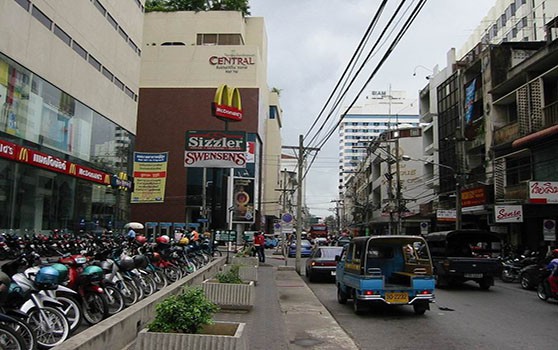 |
| Hive of activity for Malaysians |
 |
| Hatyai, a popular town for Malaysians and Singaporeans |
Hatyai will be gathering speed because the number of travellers are growing, yearly. The reason why Malaysia ICQS is renovating is because they need the facilities to accommodate the numbers during the weekends, the festivities, holidays, and the increasing logistics numbers that will be coming not only from Thailand but the rest of Indochina and of course, China. I have already seen trucks coming as far from Yunnan province in Hatyai. Hatyai will be one of the fastest growing cities (in Thailand) and it will enhance ASEAN as the corridor for trade and tourism.
*Afterword
Earlier, I noted an asterisk (*) beside fish bowl. For those who are not familiar, a fish bowl or sometimes its called a fish tank, is a place or joint where patrons go into a club and after the music is over, a group of 15 or 20 young Thai women will parade to the front of the stage and hoping patrons will call out their numbers and select them for the night. I do not wish to use the derogatory word because for them life is hard and this is all what they can do. Most don't come from the Southern region but from Indochinese countries and rural Thailand from the North and Northeast. They all speak Thai as a way for survival. When I said their lives are hard and I do not mean it literally because the extent of their lives (if they are not Thais) are so delicate and I have seen worst. Refugees, women surviving from wars in Burma, women escaping from domestic violence either at the hands of their parents (who may want to sell them) or their husbands, women who lost their loved ones, etc. Indochinese fate will not become better if Burma, Cambodia, and Laotian governments refusing to identify ethnicities and offer resolve to large swarth of poor wastelands. Thailand forever, will receive these people and Thais have been undoubtedly generous (amongst the ASEAN neighbours) as Thailand sits in the middle of the region. Communist, dictatorship, and socialist regimes and wars have placate Indochina into oblivion. Thailand is one of the worlds most incidentiary place for HIV and AIDs infection and despite its decreasing, STDs seemed to have evolved deadlier. Hence, drugs and treatment have little answers to these evolving diseases.
Aung San Su Kyi wanted all the refugees to come home but the National League for Democracy (NLD) is only accommodating international furore. What are the programs allowed to have these people to resettle? Do they have homes, employment, or places where they can farm? How are they suppose to be treated? Will they lose their ethnic heritage? I have seen one small group of ethnic Muslim Shan (numbered in hundreds) totally disappeared from Northeast Burma, and many have settled down in Mae Sot, Thailand and earning an honest living. In Cambodia, Hun Sen is relieving the success of another premiership run in the upcoming elections. More and more Westerners are partying in Cambodia because the beer are cheap and women are easy. To accomodate more galore, more and more casinos are built in Cambodia. The Laotian government is inundated with Chinese to build and modernize, however, more than 65% of the country is reeling in poverty and many do not have feasible heating in winter. More and more Chinese came down from neighbouring Yunnan province and they, themselves seemed satisfied with their businesses they ran because they weren't much competition from fellow Chinese. What's sad is that they don't even employ Laotians as either caretakers or staff. They seemed satisfied with their own fellowmen. So, more or less, Thailand seemed to be the sole destination for sorrow and sordid affairs. Malaysia, after this noxious election can be a fine example to many of these Indochinese countries, and hopefully, its not Thai Rak Thai but ASEAN Rak ASEAN.


